
How Tilt & Turn Windows Work: The Full Mechanism Explained
At first glance, a tilt & turn window looks pretty simple, no hassle. You have one handle, a clean frame, and no obvious moving parts. But behind that is a carefully engineered system that allows one window to do multiple jobs without sacrificing its performance.
This post breaks down how tilt & turn windows actually work, step by step, and why that mechanism matters for everyday living.
One Handle, Multiple Functions
The main feature you’ll notice in a tilt & turn window is that one handle controls everything.
Instead of separate latches, cranks, or locks, the handle position determines how the window is going to behave:
- Handle down → this means the window is fully closed and locked
- Handle turned upward → here, the window tilts inward from the top
- Handle turned sideways → window swings fully inward
This isn’t a gimmick. The handle is directly connected to the internal hardware system that engages different modes safely and intentionally. You’re not forcing the window into position — the mechanism is designed to guide it.
What Happens Inside the Frame
Inside a tilt & turn window is a network of steel hardware that runs around the entire perimeter of the sash.
When you move the handle, several things happen at once:
- Engages or disengages locking points
- Controls which hinges are active
- Determines how far and in what direction the sash can move
These are some of the reasons why tilt & turn windows feel solid and controlled. It’s supported evenly across the frame and isn’t hanging on one hinge or latch.

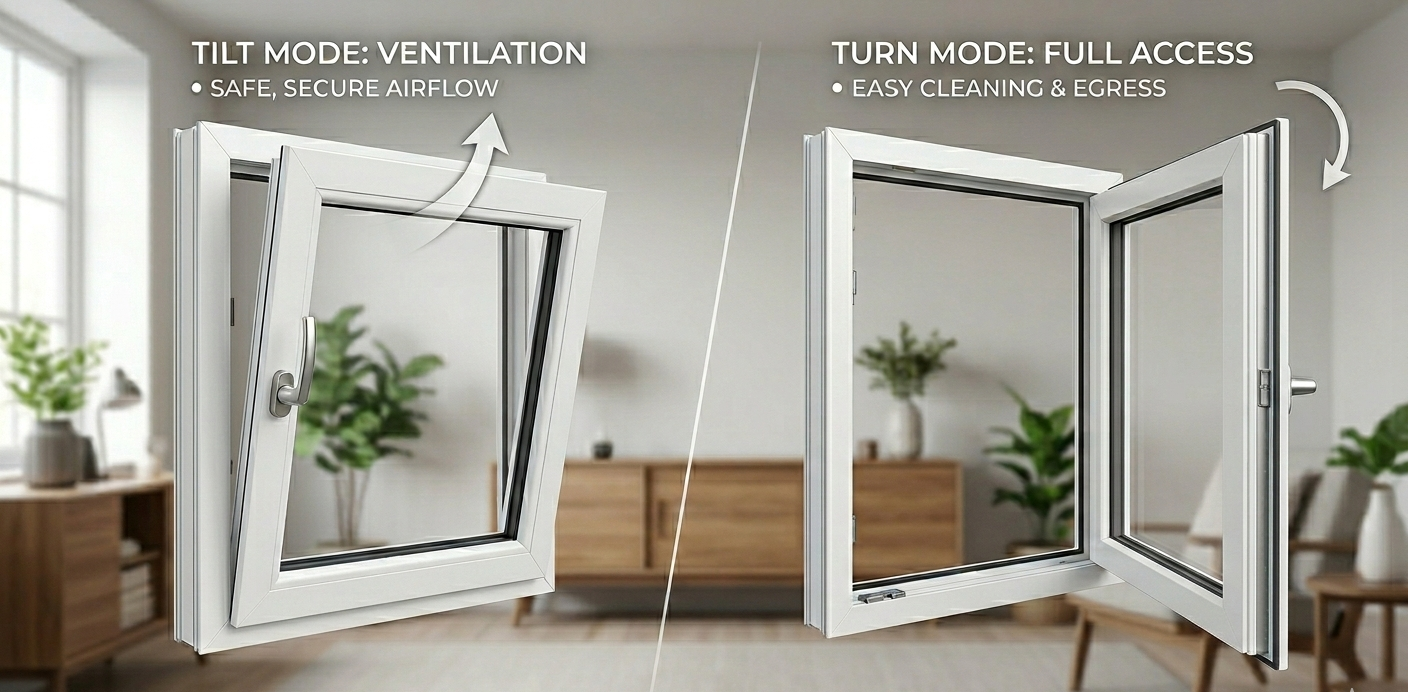
Tilt Mode: This controls Ventilation
In this mode, the top of the window opens inward while the bottom stays securely in place. Mechanically, this is achieved by locking the bottom and sides and allowing movement only at the top hinge points.
This creates a narrow opening that lets warm air escape upward while fresh air enters gently. Because the opening is limited and positioned in a much higher place:
- It’s more secure than fully opening the window
- It’s safer for homes that have children or pets
- It lessens drafts compared to wide-open windows
Tilt mode gives you ventilation without disruption.

Turn Mode: Full Access When You Need It
When the handle is turned sideways, the window switches to turn mode. In this position, the entire sash swings inward like a door, all locking points disengage evenly, and the window opens wide and unobstructed.
This mode is used for:
- Cleaning the exterior glass from inside the home
- Emergency egress (when sized correctly)
- Maximum airflow
What’s important is that the same window can fully open without weakening its seal or structure when closed.
Why Compression Seals Matter
Traditional window frames often rely on sliding tracks or simple weatherstripping. Tilt & turn windows work differently. When closed, the sash presses firmly into the frame using compression seals. The locking hardware pulls the window tight from multiple points around the perimeter.
This creates a more airtight seal, better insulation, reduced noise infiltration, and fewer drafts over time. The mechanism isn’t just about movement — it directly affects comfort and energy performance.
Multi-Point Locking: Built Into the Design
Another feature to look forward to is the multi-point locking mechanism. Instead of just locking at a single place, tilt & turn windows secure the sash at several points around the frame when it’s closed. These locking points are engaged automatically by the handle.
This provides improved security, even pressure on the seals, and better long-term alignment. It also reduces wear on any single component, which helps the window maintain performance over many years.
Why the Mechanism Feels Different in Daily Use
Homeowners often say tilt & turn windows “feel better” to operate — and that’s not subjective. Because the sash is supported evenly, the hardware is reinforced, and the movement is guided, not forced. There’s no rattling, sticking, or flexing. The window opens and closes with intention.
Where You’ll Typically See This System Used
Tilt & turn mechanisms are common in residential construction, energy-efficient homes, and multi-story buildings. They’re also increasingly specified in North American homes where homeowners want fewer compromises. For those exploring European-style systems, Hawkeye provides detailed product pages that show how these mechanisms are implemented.
Final Thought
Tilt & turn windows aren’t complicated — they’re intentionally designed. Its mechanism is made in a way that allows one window to ventilate safely, open fully, seal tightly, and lock securely, all without extra parts or confusion. The more you understand how the system works, the more you get why so many homeowners and builders choose it over traditional window styles. It’s not about having more features. It’s about having the right ones, working together.
Frequently Asked Questions
Is the handle on a tilt and turn window hard to use?
Not at all. It’s actually designed to be smoother than a traditional crank. One sturdy handle does it all—point it down to lock, turn it 90 degrees to swing it open, or flip it all the way up to tilt it. It feels solid because it’s guiding a network of steel, not just a flimsy latch.
What keeps the window from falling out when it’s tilted?
It’s all in the internal hinges. When you tilt the window, the hardware automatically locks the bottom and sides into the frame while only releasing the top. It’s physically impossible for the window to fall out because the mechanism only activates certain pivot points based on where you put the handle.
Why do these windows feel so much heavier than standard ones?
They feel ‘heavier’ because they are built with thicker frames and reinforced steel hardware to support the glass evenly. That weight is actually a good thing—it’s what allows the window to create a perfect airtight seal and stay aligned for decades without sticking or rattling.


